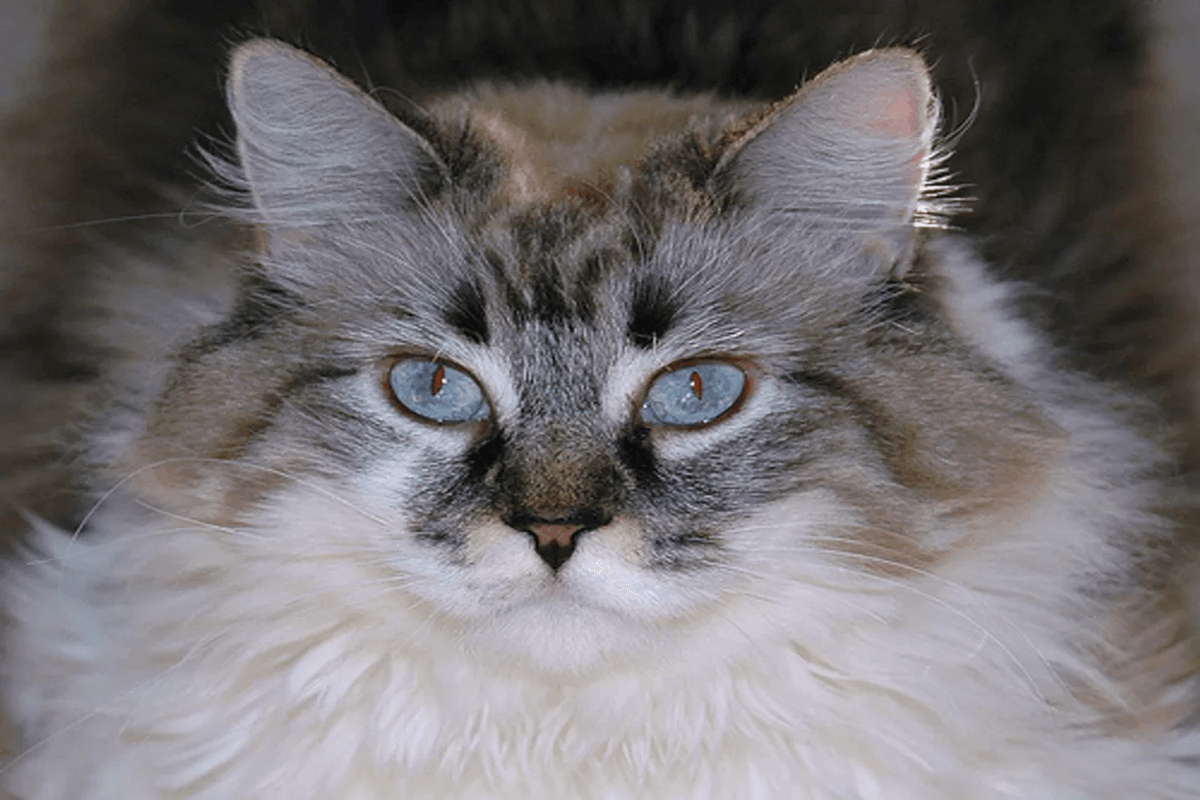
The Siberian is a triple-coated forest cat from Russia that takes five years to finish growing, molts twice a year instead of shedding constantly, and has become the breed allergy sufferers ask about most. Some of what you have read about that last part is true. A good deal of it is not.
Siberian cats worked Russian farms and storefronts for roughly a thousand years before anyone thought to write a breed standard for them. They earned their keep hunting rodents out of grain stores, and the coat that makes them so striking today was built for surviving winters most cats would not survive at all.
They reached the United States on June 28, 1990, when three kittens arrived in Louisiana after the fall of Communism opened the door to exporting them. The Cat Fanciers' Association accepted the breed as Miscellaneous in 2000, moved it to Provisional in 2005, and granted full Championship status in 2006. For a breed with a thousand years of history, its formal recognition in North America is younger than most of the people reading this.
Where do Siberian cats come from?
The breed developed in the forests of Siberia, where the climate did the selecting. Cats that survived had dense water-resistant coats, heavy bone, and the bulk to hold body heat. Nobody bred for those traits deliberately. The winters removed the cats that lacked them.
Siberians appeared at England's first cat shows in the 1700s and turned up in an American publication in 1900, which means Western cat fanciers knew about them long before the breed could be imported. What kept them out was politics, not obscurity.
Their working history still shows in their behavior. Siberians retain strong hunting instincts, they are unusually athletic for a cat of their size, and they tend to want height. An owner who provides no vertical space will find the cat inventing some.
Are Siberian cats hypoallergenic?
No cat is hypoallergenic, and the Siberian is not an exception. What is true is more interesting than the myth, and worth understanding before anyone spends two thousand dollars hoping a cat will solve an allergy.
The protein that causes most cat allergy is called Fel d 1. It is a secretoglobin protein encoded by two genes, and cats produce it largely in their saliva and in the sebaceous glands of their skin. When a cat grooms, that protein spreads across the coat, dries, and travels on shed skin and hair. It is present in about 90% of cat allergy cases, which makes it the single thing worth measuring.
Some individual Siberians carry genetic variants that result in lower Fel d 1 production. That finding is real and it is documented. What has not been established is that the breed as a whole produces less. The evidence covers individual cats, not populations, and the research on whole breeds is held up by the absence of a widely available and accurate genetic test. Anyone who tells you Siberians are a low-allergen breed is stating something the science has not yet supported.
Three other factors matter as much as breed, and they are often left out of the conversation:
- Female cats produce less Fel d 1 than unneutered males
- Neutered males produce levels close to females, so neutering meaningfully reduces output
- Kittens produce less than adults, which is why a kitten can seem fine and then trigger symptoms a year later
All of those cats still produce enough Fel d 1 to cause symptoms in a sensitive person. Lower is not zero.
The practical advice for an allergy sufferer considering a Siberian is to spend real time with the specific adult cat, not the breed. Several hours in a room with that individual animal tells you more than any pedigree claim. A responsible breeder or rescue will allow it. One who refuses is telling you something.
How big do Siberian cats get?
Siberians are medium to large cats with pronounced size difference between the sexes. Males commonly reach 15 to 20 pounds, females 10 to 15. The CFA notes reports of altered males weighing as much as 25 pounds, which is large for a domestic cat but well short of the exaggerated figures that circulate online.
The number that surprises new owners is not weight but time. Siberians are slow to mature and take up to five years to fully develop, with males continuing to build muscle past that. The cat you bring home at twelve weeks is nowhere near the cat you will have at five years. Anyone judging a young Siberian against adult photographs is comparing an animal to its own future.
What is a Siberian's coat like, and how much do they shed?
The coat is the breed's defining feature: very dense, water-resistant, medium to long, and built in three layers. It runs fuller in winter and shorter in summer.
Here is the part that works in an owner's favor. Siberians molt twice a year, each molt lasting roughly ten days, rather than shedding steadily year-round. Those two weeks are genuinely dramatic and require daily brushing. The rest of the year the coat largely takes care of itself, and the triple coat resists tangling without constant intervention. Owners who expect Persian-level maintenance are usually relieved.
Plan on a thorough brushing once or twice a week outside of molting season, and daily during it. Some owners use a professional groomer every eight weeks. Most do not need to.
What is a Siberian cat's personality like?
Siberians are described consistently, across sources and across owners, as dog-like. They meet people at the door. They follow their person from room to room. Many of them play fetch and keep playing it into old age, which is unusual in a breed that takes five years to grow up and then seems to decide adulthood is optional.
The CFA describes an intuitive quality to their attachment, an apparent awareness of which family member needs company on a given day. That is a soft claim and worth treating as such, but it appears often enough in owner accounts to be worth mentioning.
They are generally excellent with children and with other animals, including respectful dogs. They are also high-energy and strongly inclined to hunt, and a Siberian without enough to climb, chase, and investigate will gain weight. Obesity is a real risk in this breed, and it is preventable with vertical space, interactive play, and portion control.
Siberian cat vs Maine Coon vs Norwegian Forest Cat
These three are confused constantly, and for good reason. All three are large, long-haired, water-resistant northern breeds that developed in cold climates. The differences are in the shapes.
| Feature | Siberian | Maine Coon | Norwegian Forest Cat |
|---|---|---|---|
| Overall impression | Circles and roundness | Rectangles, long body | Triangles, angular face |
| Body shape | Barrel-chested, compact power | Long and rectangular | Somewhat smaller, leaner |
| Face | Rounder features | Squarer muzzle | Distinctly triangular head |
| Coat | Dense triple coat, water-resistant | Water-resistant, shaggy | Water-resistant double coat |
| Time to maturity | Up to 5 years | 3 to 5 years | 4 to 5 years |
The single most useful test is the one the CFA uses: the Siberian reads as circles and roundness, while the other two forest breeds read as rectangles and triangles. Once you have seen it, the three stop looking alike.
How long do Siberian cats live, and what health problems do they have?
Siberians typically live 12 to 15 years. They are a robust breed with one health concern serious enough that any prospective owner should understand it before buying or adopting.
That concern is hypertrophic cardiomyopathy, or HCM, the most common heart disease in cats. It causes the muscular walls of the heart to thicken, which reduces the volume of the heart chamber and impairs the muscle's ability to relax. The consequences can include rapid heartbeat, oxygen starvation of the heart tissue, and dangerous blood clots.
The Siberian appears on Cornell University College of Veterinary Medicine's list of predisposed breeds, alongside the Maine Coon, Ragdoll, British Shorthair, American Shorthair, Sphynx, Bengal, Chartreux, Norwegian Forest Cat, and Persian.
The difficult part is that many affected cats show no signs at all. The symptoms to watch for are:
- Labored or rapid breathing
- Open-mouthed breathing
- Lethargy or a sudden drop in activity
- Acute hind limb pain or paralysis, which can indicate a blood clot
- Sudden death, which is rare but possible
HCM is diagnosed by echocardiography, an ultrasound of the heart. Genetic tests can identify elevated risk, though not every cat carrying a mutation goes on to develop the disease. Ask any breeder directly whether their breeding cats are echocardiogram-screened and how often. A breeder who cannot answer that question clearly is not one to buy from.
Beyond HCM, the breed carries a slightly elevated risk of feline lower urinary tract disease. Adequate water intake and a diet that supports urinary health are the standard preventive measures, and a veterinarian can advise on both for your specific cat.
How much does a Siberian cat cost?
Expect roughly $1,000 to $2,000 from a reputable breeder, with price varying by region, pedigree, and whether the cat is sold as a pet or with breeding rights. Cats advertised well below that range warrant scrutiny rather than excitement.
The purchase price is not the real cost. Budget for the echocardiogram screening history you should be asking about, routine veterinary care across a 12 to 15 year lifespan, and the vertical furniture an athletic cat of this size genuinely needs.
Can you adopt a Siberian cat instead?
Yes, and more often than most people expect. Purebred cats end up in shelters and rescues for the same reasons any cat does: a move, a divorce, a landlord, an illness, a death in the family. None of those reasons has anything to do with the cat.
Breed-specific rescues exist for most recognized breeds and they are the first place to look. Love Meow has covered cats who came through breed rescue and landed exactly where they belonged, including a Bengal pulled from an overwhelmed Utah shelter by Bengal Rescue who turned out to be a rare cuddle-seeking member of a breed known for the opposite.
Three places to start:
- Breed-specific rescue groups. Search for Siberian rescue in your region and check the national breed clubs, which often maintain rehoming lists
- Local shelters. Ask to be notified if a long-haired cat matching the description comes in. Shelters rarely have breed papers, and a great many Siberian-type cats are listed as domestic long hair
- Breeder retirement programs. Responsible breeders retire breeding cats at a certain age and place them in homes, usually for a fraction of a kitten price
An adopted adult also solves the allergy problem in a way a kitten cannot. You are meeting a fully grown cat producing adult levels of Fel d 1, which means the time you spend with that cat tells you the truth about how you will react to it.
Is a Siberian the right cat for you?
A Siberian suits a household that wants an involved, athletic, talkative cat and can provide climbing space and daily engagement. They are good with children, good with other animals, and they stay playful for life.
They are a poor fit for someone who wants a low-interaction cat, someone who cannot handle two intense shedding periods a year, or someone buying on the assumption that the breed will not trigger their allergies. That last one is the mistake that ends with a cat back in rescue, which is the outcome nobody wants.
For more on living with cats, browse our rescue coverage and Best Of collections, where the cats who found the right homes show what a good match actually looks like.
Frequently Asked Questions
Are Siberian cats really good for people with allergies?
Some individual Siberians carry genetic variants linked to lower Fel d 1 production, the protein responsible for roughly 90% of cat allergy. That finding applies to specific cats, not to the breed as a whole, and no cat is hypoallergenic. The reliable approach is to spend several hours with the specific adult cat you are considering and see how you react. A female or neutered male will produce less Fel d 1 than an intact male regardless of breed.
How big does a Siberian cat get?
Males commonly reach 15 to 20 pounds and females 10 to 15, with the CFA noting reports of altered males up to 25 pounds. They take up to five years to reach full size, and males continue building muscle past that point, so a young Siberian is not a fair preview of the adult cat.
Do Siberian cats shed a lot?
Less than their coat suggests, most of the year. Siberians molt twice annually for about ten days each time, rather than shedding steadily. Those two periods require daily brushing. Outside of them, once or twice a week is generally enough, because the triple coat resists matting on its own.
How long do Siberian cats live?
Typically 12 to 15 years. The main health concern is hypertrophic cardiomyopathy, a thickening of the heart walls that is the most common heart disease in cats and that the breed is predisposed to. It is diagnosed by echocardiogram, and screening history is a reasonable thing to ask any breeder about.
What is the difference between a Siberian and a Maine Coon?
Both are large, long-haired, water-resistant northern breeds. The Siberian reads as circles and roundness, with a barrel chest and rounder facial features. The Maine Coon reads as rectangles, with a longer body and a squarer muzzle. The Norwegian Forest Cat, the third breed commonly confused with these two, reads as triangles and has a distinctly angular head.
Can I find a Siberian cat in a rescue?
Yes. Purebred cats enter shelters and rescues for the ordinary reasons any cat does. Start with breed-specific rescue groups and national breed clubs, which often keep rehoming lists, and ask local shelters to notify you when a long-haired cat matching the description arrives, since shelters rarely have papers and many Siberian-type cats are listed as domestic long hair. Breeders also retire breeding cats into homes, usually well below kitten prices.
Sources
- The Cat Fanciers' Association, Siberian breed profile
- Cornell University College of Veterinary Medicine, Hypertrophic Cardiomyopathy
- Fel d 1, allergen composition and production